
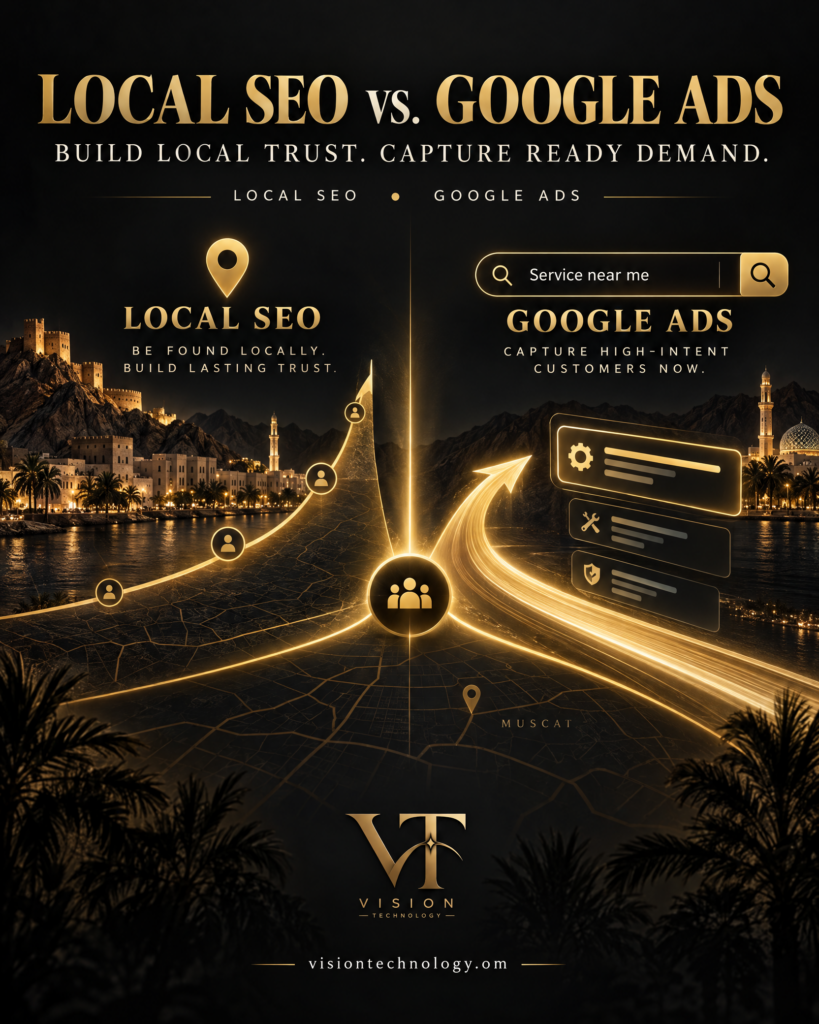
When someone in Muscat searches for a service they need now—such as a consultant, clinic, contractor, maintenance provider, training company, or digital agency—they may see two different routes to a business.
One route is the local results in Google Search and Google Maps. The other is a paid search advert at the top of the results page.
For many Omani service businesses, the question is not whether either route matters. It is where to invest first, how to measure the outcome, and how to avoid treating two different growth tools as though they do the same job.
Local SEO builds the business’s local visibility and trust over time. Google Ads captures eligible search demand while the campaign is active. The most sensible choice depends on the commercial problem you need to solve first.
First, Understand What Each Channel Is Designed to Do
Local SEO helps people find and trust your business locally
Local SEO is the work of making a business easier to discover in the organic local results on Google Search and Maps. For a service business, that usually includes an accurate Google Business Profile, clear location and service information, useful service pages on the website, genuine customer reviews, and a consistent local reputation.
Google explains that local results are mainly based on relevance, distance, and prominence. Relevance is how closely a Business Profile matches the search. Distance reflects how far the business is from the searcher or the location they specify. Prominence reflects how well known the business is, with signals including links to the business and the volume and quality of reviews. [1]
This is an important reality for a Muscat business to understand: there is no paid shortcut to a better organic local ranking. Google says there is no way to request or pay for one. [1] A complete and accurate profile can improve the chances of appearing for relevant local searches, but it cannot remove the role of distance or guarantee a particular position.
Local SEO is therefore a strong investment when your service is geographically relevant and customers repeatedly search for it near a neighbourhood, city, or service area. A well-maintained profile helps a prospect answer basic trust questions quickly: Where are you? Are you open? What do you offer? Have other people had a good experience?
Google Ads captures people actively looking for a service
Google Search campaigns use text adverts in search results. Google says these campaigns can reach people while they are actively searching for the products and services a business offers, making them useful for leads, sales, or website traffic. [3]
For a service provider, that means an advert can be aligned to specific commercial searches such as “office fit-out company Muscat,” “PPC agency Oman,” or “air-conditioning maintenance near me.” The advertiser chooses the budget, targeting, keywords, advert message, landing page, and conversion measurement.
The advantage is control and speed of entry. A campaign can start attracting relevant searches once it is approved and eligible to serve. The trade-off is that the business pays for qualified traffic, needs clear conversion tracking, and must continue managing the campaign while it spends. Ads do not create a permanent organic map position simply because they run.
The Decision Is Not “Free SEO” Versus “Expensive Ads”
It is tempting to frame Local SEO as free and Google Ads as expensive. That framing is misleading.
A Google Business Profile is free to create and manage, but good Local SEO still requires time and operating discipline. Someone must keep the address, opening hours, categories, contact details, service information, photos, and website links accurate. Someone must ask satisfied customers for honest reviews and reply properly to feedback. The website itself must explain the services clearly enough for a prospective customer to understand the offer.
Google specifically recommends complete business information, responses to reviews, and photos or videos on a Business Profile. It also notes that more reviews and positive ratings can help a business’s local ranking. [1] That is not a reason to buy reviews or offer incentives for them. Google requires reviews to reflect genuine experiences and prohibits offering free or discounted goods or services in exchange for reviews, review changes, or review removals. [2]
Google Ads has a visible media cost, but it can make commercial sense when a business needs to test demand for a new service, support a time-sensitive offer, protect visibility for high-intent terms, or create a predictable flow of measured enquiries while its organic local presence develops.
The relevant question is: Which channel is most likely to create qualified conversations for the business’s current situation?
When Local SEO Should Lead the Investment
Local SEO should usually be the first priority when the business depends on a defined service area and expects customers to search for it repeatedly over time.
This is common for practices, home services, local B2B providers, training companies, repair specialists, and professional services. If prospects want proof of location, contact details, opening hours, reviews, or directions before they enquire, the Google Business Profile is not optional housekeeping. It is part of the sales journey.
Prioritise Local SEO first when these conditions are true:
- The business serves a clear area. A customer in Muscat, Seeb, Al Khuwair, or another defined location is more likely to care about proximity or service coverage.
- The service is not a one-week campaign. The business expects demand to exist throughout the year, not only during a short promotion.
- The team can maintain accurate public information. A profile with incorrect hours, old phone numbers, or unclear service categories creates friction at the point of decision.
- The business can earn genuine proof. Reviews, responses, photos, and useful service information can be refreshed without shortcuts or policy risks.
- The website can support the local offer. Visitors who click from Maps or Search should arrive at a page that clearly explains the relevant service and gives them an easy next step.
A practical first move is not to chase a vanity ranking. It is to audit whether the profile reflects reality. Check the primary category, address or service area, hours, phone number, website, services, photos, and review response process. Then make sure the corresponding website page answers the same questions clearly.
When Google Ads Should Lead the Investment
Google Ads should lead when the business needs to capture high-intent demand before an organic local presence has had time to develop, or when it needs more control over a specific commercial message.
A campaign is especially useful when launching a new service, opening a new location, promoting a time-sensitive consultation, or targeting a service where the commercial value of one qualified lead is high enough to justify measured acquisition cost.
Prioritise Google Ads first when these conditions are true:
- There is an urgent demand-generation need. The sales team needs qualified conversations now rather than only future visibility.
- The offer is specific. A focused search advert and landing page can make a precise promise, such as a paid-media audit, emergency maintenance visit, or consultation.
- The business can handle the leads. Fast response, call handling, WhatsApp follow-up, and a relevant landing page are part of the campaign—not tasks to solve later.
- Conversion actions can be measured. Track the actions that sales actually value: qualified calls, completed forms, booked consultations, or meaningful WhatsApp conversations.
- The account will be managed. Search terms, keyword matching, location settings, bid strategy, landing-page relevance, and lead quality need regular review.
The goal is not simply to generate a low-cost click. It is to create a measured path from a relevant search to a qualified business conversation.
The Strongest Approach: Use Both Channels for Different Jobs
For many established service businesses in Oman, the best strategy is not to choose one channel forever. It is to use each channel for the job it does best.
Local SEO gives the business a credible local foundation. It helps customers verify who the business is, where it operates, what it does, and what others say about it. That foundation remains useful whether or not an advert is running.
Google Ads gives the business an active demand-capture tool. It can place a focused offer in front of people searching for a specific service, route them to a matching landing page, and show which messages and search themes produce qualified enquiries.
A practical combined model looks like this:
| Business need | Local SEO role | Google Ads role |
|---|---|---|
| Trust before enquiry | Accurate profile, reviews, photos, service details, website clarity | Reinforce a specific relevant offer |
| Demand from high-intent searches | Support relevance and credibility when prospects compare options | Capture active searches with targeted adverts |
| New service or campaign | Add accurate service information and helpful proof | Test focused search terms and a campaign-specific landing page |
| Longer-term visibility | Build durable local presence through consistent maintenance | Support priority terms or periods when immediate lead flow matters |
| Lead-quality learning | Reveal customer questions through reviews and profile interactions | Measure which searches, ads, and pages create useful enquiries |
The connection matters. A person may click an advert, then check the Business Profile before contacting the company. Another may discover the profile in Maps, visit the website, and later search again before clicking an advert. The customer does not experience your channels in separate silos, so the business should not manage them that way.
What to Measure So the Decision Stays Commercial
Do not judge either channel by visibility alone.
For Local SEO, track actions that indicate real intent: calls from the Business Profile, website visits, direction requests where relevant, quality and consistency of reviews, and enquiries that mention Maps or Google Search. Keep the focus on accuracy and customer confidence—not on a promise to rank first for every search.
For Google Ads, track qualified lead actions rather than raw clicks. Separate a useful consultation request from an incomplete form, a wrong-number call, or a casual information request. Review search terms to understand what people actually typed before they reached the advert. Compare the cost of qualified enquiries with the business value of those conversations.
The business should also watch what happens after the enquiry. A campaign cannot solve slow sales follow-up, unclear pricing, or a poor landing page. Local visibility cannot compensate for an unanswered call. The marketing investment works best when the customer path—from search to response—is clear and accountable.
A Simple Priority Framework for Omani Service Businesses
If budget is limited, begin by fixing the local foundation: verify the Business Profile, complete the details, correct the contact information, show accurate services and coverage, request genuine feedback from real customers, and give prospects a helpful service page to visit.
If the business needs enquiries for a specific service now, add a focused Google Search campaign. Use tightly relevant keywords, a landing page that repeats the advert’s promise, and one measurable conversion action. Do not send paid visitors to a generic homepage and hope they find the right service.
If the business is established and ready to grow, combine the two. Let Local SEO build the credibility and local presence that prospects can verify. Let Google Ads capture priority demand and generate search-term insight. Then improve both channels based on the quality of enquiries—not just the number of clicks or impressions.
Build the Channel Mix Around the Customer’s Moment of Need
The answer to “Local SEO or Google Ads?” is usually a question of timing and intent.
Local SEO is the investment that helps an Omani service business become easier to find and easier to trust in its market. Google Ads is the acquisition tool that helps the business show a relevant offer when a person is actively searching for it.
The right first move is the one that removes the biggest constraint. If the business is hard to verify locally, fix that foundation. If it has a strong local presence but needs qualified conversations for a priority service, build a focused Search campaign. If both are important, connect them around the same message, service area, landing page, and sales follow-up process.
Vision Technology helps Omani businesses combine high-intent PPC acquisition with a practical local-search foundation. If you want to know where your budget can produce the clearest next improvement, request a free paid-media and local-visibility review.