
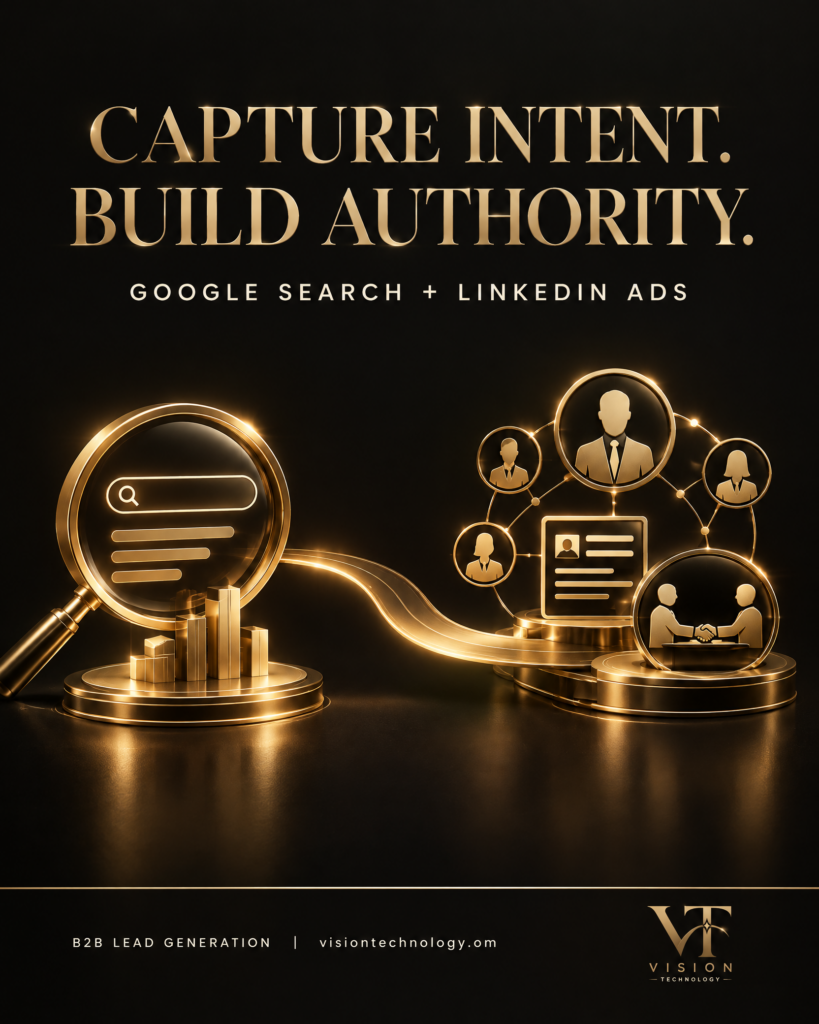
A B2B buyer does not usually choose a digital partner, software provider, consultant, or specialist service after one advertisement. The journey often begins with a practical problem: a company needs qualified leads, a better customer-retention system, improved reporting, or a more reliable performance-marketing partner. The buyer searches for answers, compares options, and needs evidence before starting a conversation.
That is why Google Search and LinkedIn Ads can work well together when they are assigned different jobs. Google Search captures active intent. LinkedIn helps a business remain credible and relevant after that first visit.
Google describes Search campaigns as text ads that reach people while they are actively searching for products and services. It positions them as useful for sales and leads, especially where a business needs specific targeting. [1] LinkedIn’s website-retargeting tools, meanwhile, let advertisers build audiences from LinkedIn member accounts that visited selected pages on their website, provided the Insight Tag is installed and the audience reaches platform eligibility. [2]
This is not a shortcut that turns every click into a contract. It is a structured way to move a high-intent visitor from an initial search into a clearer B2B buying journey.
Give Each Channel One Clear Job
The most common weakness in multi-channel B2B advertising is asking every channel to do everything. A business may use LinkedIn to chase cold clicks with a hard sales message, then send high-intent Google Search visitors to a generic homepage. Neither step reflects the buyer’s stage.
A better structure is simpler.
| Channel | Primary job | Best starting message | Useful next action |
|---|---|---|---|
| Google Search | Capture existing demand | Solve the specific problem the buyer searched for | Request an audit, consultation, demo, or proposal discussion |
| Landing page | Convert interest into a measurable next step | Explain the offer, proof, scope, and next action | Submit a form, call, or start a WhatsApp conversation |
| LinkedIn retargeting | Reinforce authority after a website visit | Show useful expertise, a framework, proof point, or buyer guide | Return to the relevant page, download a resource, or book a conversation |
| Sales follow-up | Qualify and progress genuine opportunities | Respond to the stated need, not a generic script | Schedule the appropriate next meeting |
The sequence matters. Google Search is valuable because the person has expressed a need through a query. LinkedIn is valuable because the business can keep showing a consistent, professional message to eligible people who already interacted with its site. The landing page connects the two with a clear offer and measurable conversion.
Start with the Search Terms Your Ideal Client Would Use
For an Omani B2B company, the strongest search campaign rarely begins with every possible marketing keyword. It begins with a small group of commercial, problem-led search themes that clearly match the service being sold.
A performance-marketing agency might group campaigns around searches such as Google Ads management, PPC agency in Oman, WebEngage implementation, customer-retention automation, or paid-media audit. A technology provider might structure campaigns around a defined product category, integration, support service, or industry-specific solution.
The objective is not to generate the most traffic. It is to attract the people whose search indicates a problem the business can genuinely solve. Each group should lead to a page that continues the same message. Someone searching for a paid-media audit should arrive at an audit-focused page. Someone researching WebEngage should arrive at a page that explains the platform, the use cases, and the consultation path.
This alignment protects budget and makes the visitor’s next step easier to understand. It also gives the business a more useful basis for evaluating lead quality after the click.
Build a Landing Page That Creates a Useful Signal
A B2B landing page does more than collect an email address. It records the commercial context behind an enquiry.
Instead of a single generic form, ask only for the information that helps the sales team respond well. This may include the company name, business type, service needed, approximate marketing objective, and preferred contact method. The form should stay proportionate to the offer. A free guide may require less information than a request for an audit or proposal.
The page also needs one clear promise. It may offer a paid-media audit, an assessment of the current lead-generation process, or a short consultation on a defined challenge. Avoid sending paid-search visitors to a broad homepage where they must choose among unrelated services.
Vision Technology’s paid-media landing page already provides a focused path for Google Search and Meta Ads prospects, with an audit request form and direct WhatsApp option. Explore the paid-media growth page →
Use LinkedIn Retargeting as a Second Conversation, Not a Repeat of the First Ad
A person who has visited a landing page has shown more intent than someone who has never encountered the business. But a visit alone does not explain what they need next. This is where useful LinkedIn retargeting differs from simply showing the same sales message repeatedly.
The LinkedIn Insight Tag can support conversion tracking, website audiences, and audience insights for LinkedIn member accounts that visit a site. [3] Once the appropriate permissions and consent arrangements are in place, an advertiser can create an audience for visitors to a defined page, such as a paid-media audit page or a WebEngage service page. [2] LinkedIn notes that an audience requires at least 300 matched member accounts before it can be used for ad-set targeting. [2]
Use that audience to change the conversation. A visitor who saw an audit offer may respond better to a short post explaining how to review search terms, an executive checklist for assessing lead quality, or a concise example of how a weak landing page affects paid-media results. The purpose is to give the buyer a reason to remember the business and return when they are ready—not to follow them with generic ads.
A practical 30-day message sequence
A 30-day window is a useful starting test, not a universal rule. The right duration depends on sales-cycle length, audience size, privacy requirements, and the frequency that remains helpful rather than intrusive.
| Stage | Message focus | Example asset or call to action |
|---|---|---|
| Days 1–7 | Clarify the problem the visitor came to solve | “Five checks before increasing your Google Ads budget” |
| Days 8–20 | Demonstrate expertise and the decision process | A short framework, checklist, carousel, or technical explainer |
| Days 21–30 | Invite the right next conversation | “Request a paid-media audit” or “Book a 20-minute discovery call” |
Do not treat the timing as an automatic sequence that should be applied without review. Watch frequency, audience size, click quality, and consultations created. If the audience is too small to meet platform eligibility, focus first on qualified Google Search traffic and useful LinkedIn organic content while the eligible website audience builds.
Do Not “Sync” a Google Ads Audience to LinkedIn
It is tempting to think of retargeting as a single audience that moves automatically from platform to platform. In practice, the safer approach is to build each platform’s audience through its own approved measurement setup.
For this campaign structure, Google Search sends relevant visitors to a dedicated landing page. The LinkedIn Insight Tag, implemented with the required permissions or consent, can then create an independent LinkedIn website audience from eligible visitors. LinkedIn explains that the tag uses cookies and a first-party pseudonymous identifier for its reporting and retargeting features, and it states that customers are responsible for obtaining necessary permissions or consents before sharing data with LinkedIn. [3]
This distinction matters for three reasons. First, it keeps the measurement design clear. Second, it prevents a business from assuming that every Google visitor will become available for LinkedIn advertising. Third, it encourages the team to treat privacy and customer trust as part of campaign quality, not as a late-stage technical task.
Measure the Journey, Not Just the Last Click
A combined Search and LinkedIn strategy should not be judged only by cheap clicks or a single platform’s lead count. Review the journey in layers.
Start with the quality of Google Search traffic: Which queries generated relevant enquiries? Which campaign themes created qualified conversations? Then review the landing page: Are visitors completing the intended action, and are those submissions useful to sales? Finally, review LinkedIn’s contribution: Is the website audience reaching eligibility, are the authority-led messages producing meaningful engagement, and are retargeted visitors returning to begin a proper conversation?
The most important business metric is the same across all channels: how many qualified opportunities progressed toward revenue. Use campaign data to improve the process, but validate it with sales feedback and CRM outcomes.
A Simple Launch Checklist
Before investing in this two-channel approach, confirm the following.
- The Google Search campaign targets a small, commercial set of search themes and uses relevant negative keywords.
- Each search theme points to a dedicated landing page with one clear offer.
- Conversion tracking distinguishes a genuine consultation request from weaker engagement signals.
- The LinkedIn Insight Tag is implemented only after appropriate privacy, permission, and consent review.
- LinkedIn website audiences are built around meaningful page visits and reach the platform’s eligibility threshold before a retargeting ad set is launched.
- Retargeting creative adds useful expertise instead of repeating the original Google Search ad.
- Marketing and sales agree on what counts as a qualified lead and review results together.
Build Demand, Then Build Confidence
B2B lead generation is not about appearing everywhere at once. It is about being useful at the moments that matter.
Google Search gives Vision Technology a way to reach businesses actively looking for paid-media, PPC, or retention expertise. LinkedIn gives the brand a structured opportunity to reinforce that expertise after an eligible site visit. The landing page, conversion setup, and sales follow-up turn those channel interactions into a measurable commercial process.
If you want to turn high-intent Google searches into more qualified B2B conversations, Vision Technology can review your Search campaign, landing-page path, and retargeting readiness in a free paid-media audit.